
✨🍼 Artificial intelligence faces a fertility test
If AI undermines confidence in the future, it may depress birth rates before it boosts them

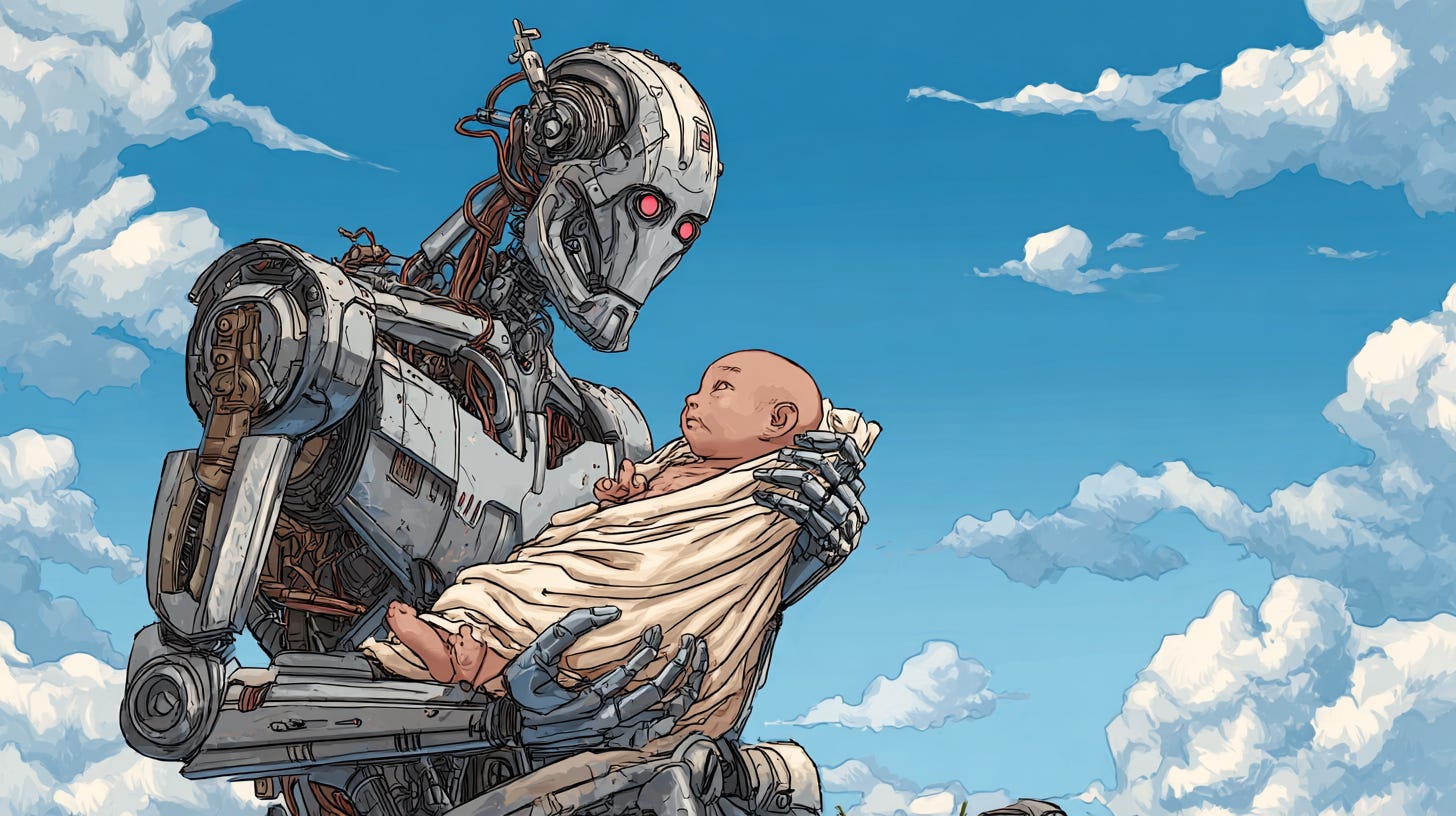
My fellow pro-growth/progress/abundance Up Wingers in the USA and around the world:
Here’s an economics finding that made my Up Wing heart skip a beat. Heck, it might well reframe the entire debate about falling global fertility: Optimism crosses borders—literally.
A new paper by economists Christos Makridis of Arizona State University and Clara Piano of the University of Mississippi uses the Meta Social Connectedness Index (a measure of cross-border friendship ties on Facebook) to show that when a) people in countries socially linked to yours become more optimistic, b) fertility in your country appears to rise for reasons not obviously driven by your own local economy.
From the paper:
A country’s citizens may become more optimistic if they are socially connected (through Facebook friendships) to people in other countries that experience positive optimism shocks. These imported sentiment shocks propagate through social networks but are unlikely to be caused by the focal country’s own economic or demographic conditions, thus providing a plausibly exogenous source of variation in local thriving.
Mood is contagious. And babies, it turns out, follow mood.
The study, “Proud to be... a Family,” covers more than 140 countries over two decades using Gallup World Poll data. The core finding is that national optimism—measured by the share of people who rate their lives highly and expect further improvement—is significantly associated with higher fertility. This holds even after you control for income, marriage, education, and female labor-force participation. When the authors zero in on cause and effect—using those cross-border waves of optimism—they find that a 10-percentage-point rise in “thriving” is associated with something like a 7–9 percent increase in fertility.
You can quibble with the magnitudes here, but the direction is hard to dismiss. Again, from the paper:
Global fertility decline is one of the defining challenges of the 21st century. Many countries are grappling with the prospect of shrinking workforces and rapidly aging populations, a scenario that has prompted alarm in policy circles. Traditional explanations for falling birth rates center on structural factors—rising education and income, women’s changing roles, inadequate support for families—and cultural shifts toward individualism. This paper adds a new dimension to our understanding of fertility determinants by demonstrating that collective optimism about the future is itself a significant driver of fertility behavior across countries.
A bet worth taking
As regular readers know, I’ve been thinking about this sort of connection for a long time. In The Conservative Futurist, I outline the key pillars that support a pro-progress society, such as a level of economic freedom that allows someone with a big idea to, in the words of economist Deirdre McCloskey, “have a go” without fighting a cage match with bureaucrat-favored incumbents.
Another pillar I identify—one more relevant for this discussion—is cultural, drawn from the postwar Dutch sociologist Fred Polak: Civilizations are steered by their “images of the future.” A society that imagines tomorrow as expansive will invest, build, and take risks. But one that imagines tomorrow as threatening will hunker down. The machinery of progress can be intact—say, nuclear reactors or generative AI models—even as the willingness to use it evaporates.
Fertility is where that framework gets personal. Having a child is probably the most consequential long-term bet most people ever place. Tax credits and paychecks matter at the margin. But what really drives the decision is the story a couple tells itself about the future—whether it feels stable and promising enough to bring someone new into.1 The Makridis-Piano paper gives that intuition real empirical weight. Affordability matters, sure. But the bigger driver is whether people deeply believe the future will make their hopes realistic.2
AI anxieties
Now let’s run that thinking through the emerging age of artificial intelligence. In one scenario—the one I’d call the Up Wing case—AI is precisely the technology that could generate a more positive image of the future. It accelerates scientific discovery, boosts productivity, lowers costs, and automates drudgery, ultimately making richer, less time-constrained lives available to far more people. And it could yet deliver John Maynard Keynes’s world of abundance and shorter hours, making larger families newly feasible. Raising kids is great way to spend your time when you’re not working your 15-hour-a-week job.
If AI delivers, the payoff goes beyond GDP. The future starts to feel governable and expansive again. People have more reasons to make long bets—including the longest bet of all. In that sense, baby bonuses are beside the point. What matters more is a civilization that grows, innovates, and converts rising abundance into a sense of real, lived security.
But that definitely isn’t how AI is landing right now. Some recent Blue Rose Research polling shows a technology arriving in a society already saturated with anxiety. Only 25 percent of Americans say they’re confident about their financial future. And voters increasingly fold AI into those broader worries. Fifty-seven percent say AI is advancing too fast, and just 18 percent are optimistic about its long-term social impact. Nearly eight in 10 worry the government has no plan to protect workers. Americans aren’t wholly anti-AI—but they don’t trust that its gains will be broadly shared. When leaders promise that productivity will benefit everyone, most people don’t believe them.
Through the Makridis-Piano lens, as I see things, this perception raises a demographic warning. Couples don’t wait for a layoff notice to rethink having a child. A general sense that jobs are becoming less secure can be enough to push the decision back. If AI raises that ambient uncertainty—even before it has materially changed wages or employment—it can depress fertility by darkening the image of the future.
Now, as far as the AI bit of this story, it's my hope that over the next year or so widespread productive impacts will emerge and become obvious, translating into wage gains—all else equal (meaning no $200 oil or Chinese invasion of Taiwan). Yes, it would be helpful if AI CEOs would quit suggesting all white-collar jobs will vaporize sometime soon, which I think is unlikely. Then again, we might get a briefer, 21st-century version of Engels' Pause—the period from roughly the 1790s to the 1840s when British real wages stagnated even as industrial productivity surged. Higher output didn't boost incomes for decades.
The long game
More broadly, the paper suggests that subsidies and childcare alone won’t move the needle much. (Plenty of other research as well.) What matters more is whether people feel confident about where their lives—and their country—are headed. Steady jobs, predictable growth,3 and less day-to-day uncertainty matter because they shape how people see the future. Policies that reduce uncertainty—whether through job security, housing, or safety nets—can shift that outlook. But the stories our leaders tell also matter:
Policymakers concerned about low fertility could thus pay closer attention to consumer confidence indices and public sentiment—treating them as both barometers and potential levers. For example, during crises, maintaining public confidence (through credible policies and communication) might prevent a collapse in fertility that would have long-run consequences.
But what if policymakers do the opposite, at least when it comes to AI? I worry that if the benefits for AI don’t appear sooner rather than later, we are about to get a presidential election of AI doomsaying—with some really bad long-term consequences.
“The number of births is the first indicator of a people’s hope. Without children and young people, a country loses its desire for the future.” - Pope Francis in 2024
This essay makes a good companion to my previous piece on the passing and legacy of population doomer Paul Ehrlich.
Makridis and Piano: “During the 2008–09 Great Recession, countries that experienced sharper drops in consumer confidence also saw larger fertility declines, even after controlling for objective economic conditions.”
On sale everywhere The Conservative Futurist: How To Create the Sci-Fi World We Were Promised

My god. This is absolutely fascinating. Truly.