
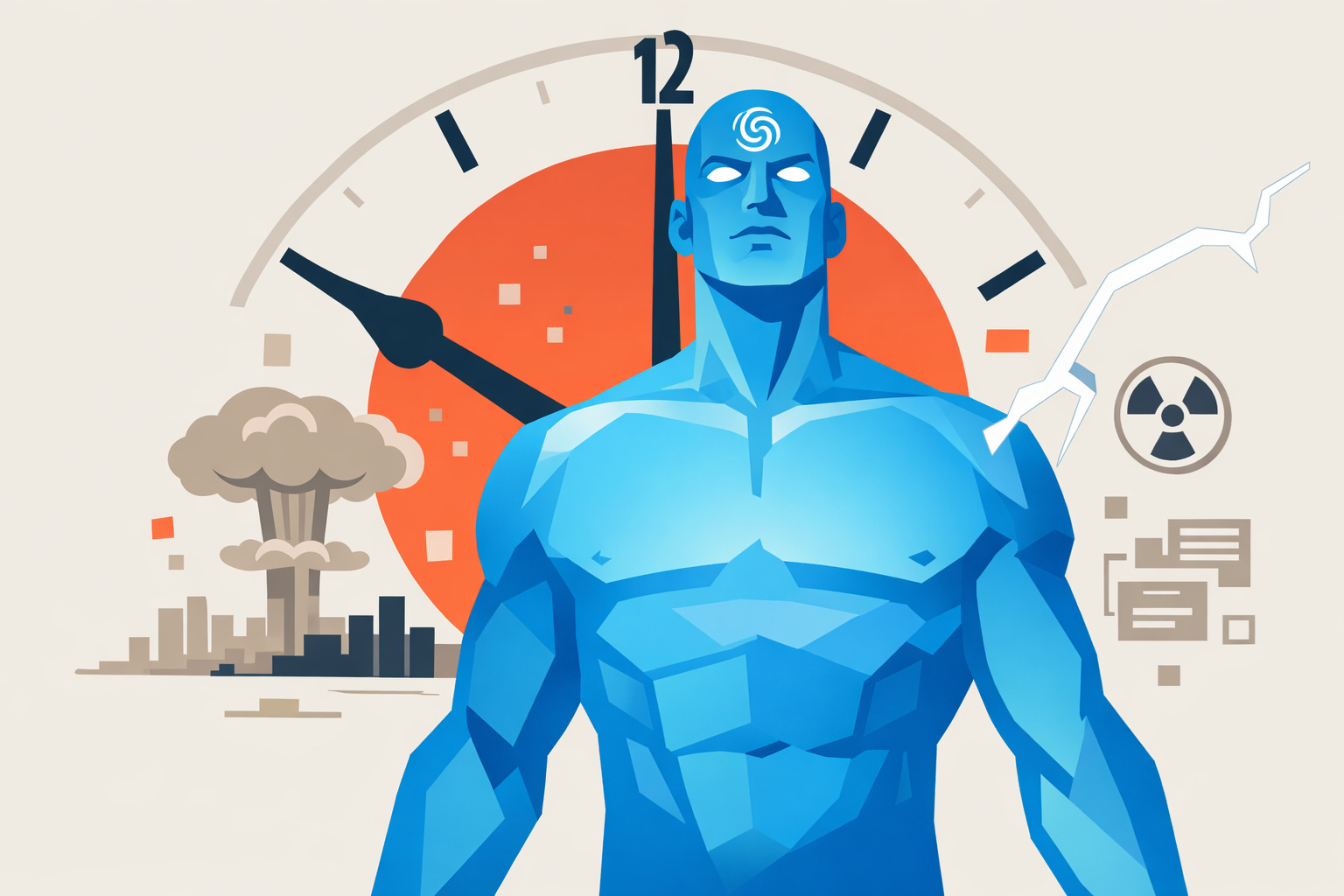
🕛 The Doomsday Clock is a myth machine
AI risks get inflated while helpful capabilities get dismissed

My fellow pro-growth/progress/abundance Up Wingers in the USA and around the world:
Artificial intelligence risks being governed as if it were a techno-god, not a digital tool. You can see it in the policy musings of politicians and pundits who propose rules for a fantastical futurity of all-powerful (and potentially all-dangerous) AI rather than today’s measurable capabilities. So long jobs, then so long people.
Caroline De Cock, a technology-policy analyst, dissects this unfortunate tendency in her book AI Tools, Not Gods. Myth-driven narratives, she argues, are warping both public debate and public policy. De Cock: “When governance is built on myth rather than evidence, we end up regulating imagined dangers and imagined miracles instead of real systems and real risks.”
Her warning, as I see it, actually fits neatly with the Bulletin of the Atomic Scientists’ latest Doomsday Clock update, which now sits at 85 seconds to Midnight, “the closest it has ever been to catastrophe.” Once a sober Cold War metaphor directly tied to US-Soviet policymaking, the Clock has become a grand narrative engine, bundling nuclear weapons, climate change, biotechnology, misinformation, authoritarianism — and now AI — into a single comprehensive countdown to humanity’s end. In this framing, AI appears less as a human-built technology than as a destabilizing Chaos God, amplifying every threat at once.
The myths haunting modern tech debates
De Cock traces modern tech debates to older storytelling traditions. AI is cast as a supernatural object that thinks for itself (à la The Sorcerer’s Apprentice), a runaway creation that turns on its maker (Frankenstein), a machine that escapes human control (The Terminator), a promised savior (Star Trek), or a corrupting moral force (Faust, Black Mirror). These archetypes repeatedly get mapped onto each new wave of technology.
In that sense, today’s purveyors of AI panic reflects a continuing habit: projecting stories about power, hubris, and doom onto tools that feel too powerful to fully understand.
Interpretively seen through De Cock’s taxonomy,1 the Doomsday Clock effectively indulges several myths at once. AI is treated as Magic — inscrutable, prone to hallucination and beyond human grasp. It is cast as Madness, blamed for accelerating informational chaos. And it becomes Sin, accused of undermining truth and corroding democratic discourse. Such as emotional storytelling substitutes for empirical analysis of what AI systems actually do, who controls them, and how accountability should work.
This countdown runs on vibes
Of course, the Clock itself has never been anything like a precisely calibrated seismograph of existential risk. Its adjustments have tracked elite anxiety at least as much as objectively calculated danger. It drifted away from midnight in the 1960s despite nuclear near-misses, and crept closer in the early 1980s in response to Ronald Reagan’s rhetoric — even though his strategy arguably hastened the Cold War’s end.
Even on its own terms, the current perspective is strikingly lopsided. The Bulletin treats technological progress — especially AI — primarily as a threat multiplier, while discounting its growing role as a risk reducer. 2
Energy offers a revealing case. The Clock catalogues climate peril but gives little weight to accelerating clean-power deployment or AI’s role in making it work. Solar, wind, advanced nuclear fission/fusion, long-duration storage, and next-generation geothermal plausible promote clean energy abundance. AI helps balance grids, forecast demand, improve battery chemistry, and perhaps eventually accelerates R&D. Far from pushing civilization toward midnight, this technological stack may be expanding its margin of safety.
Doom makes for compelling theater. But a civilization obsessed with fictional annihilation risks missing a consequential reality: Its problem-solving capacity is compounding faster than the threats stemming from its apocalyptic imagination.
Perhaps the answer isn’t to keep nudging the hands toward Midnight, but to build a different clock altogether. If the Doomsday Clock measures fear, a Genesis Clock would measure capability — tracking progress toward longer lives, disease cures, clean-energy abundance, planetary defense, and rising global prosperity. Instead of counting down to extinction, it would count up toward Dawn.
And that may be the only countdown worth taking seriously.
To be clear, I’m less enamored with AI regulations than the author, who might well disagree with my application of her approach to the Clock.
AI already improves logistics, accelerates drug discovery, strengthens fraud detection, enhances climate modeling, and optimizes complex infrastructure. Properly governed, it can bolster biosecurity rather than undermine it, and strengthen resilience in everything from disaster response to power-grid management.
On sale everywhere The Conservative Futurist: How To Create the Sci-Fi World We Were Promised
They rate at which they approach midnight has to slow down each year there's no cataclysm. The only options are it asymptotically approaches zero, or they walk it back and give themselves more room (which has happened before.
The Doomsday Clock and the BullScient is proof that Rule 34 applies to eschatology.