
My fellow pro-growth/progress/abundance Up Wingers in America and around the world:
If my podcast guest today is correct, the emergence of generative artificial intelligence "heralds a transformation more profound than anything since Homo sapiens acquired the capacity for abstract thought." That's about as pure a distillation of the San Francisco Consensus view on the importance of this technology as it gets.
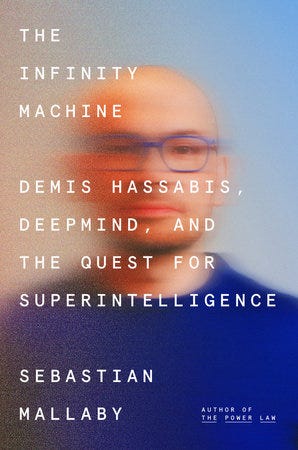
Today on Faster, Please!—The Podcast, I am joined by Sebastian Mallaby, the Paul A. Volcker Senior Fellow for International Economics at the Council on Foreign Relations and a widely read columnist for The Washington Post. He is also the author of the new best-selling book The Infinity Machine: Demis Hassabis, DeepMind, and the Quest for Superintelligence.
(Spoiler: It’s tremendous book about the man, the company, and the technological revolution. I really liked it.)
We discuss The Infinity Machine and the life of Demis Hassabis, including how his original vision for artificial superintelligence compares with the propulsive race unfolding today. We also explore how that competitive acceleration has affected the focus on safety, what role government regulation should play, and why many people may still be underestimating how transformative AI will become.
The Quest for “Success” (0:27)
Inside the Mind of Hassabis (8:29)
The Race for Monopoly (12:31)
The Economics of AI Anxiety (17:05)
Governing the AI Race (24:17)
The Biggest Leap Since Abstract Thought (30:13)
A lightly edited transcript of our conversation will appear in my Week in Review issue on Saturday. (Another option is using the Substack auto transcript function.)
But here are some edited highlights from the chat:
On where AI is heading…
You look backwards; you see how fast the progress has been. To merely extrapolate forwards is probably to undersell the speed at which we’ll accelerate in the future because there’s an accelerating phenomenon here where the more advanced you are, the easier it is to get to the next level.
On Hassabis’s belief that AI development would look more like the Manhattan Project than a multi-country, multi-company competition …
In retrospect, it’s crazy. All one can say is that ex ante, the atmosphere in the community of AI builders when Demis began his company in 2010 was that this was a thing that simply didn’t work. AI could not recognize the photograph of a cat. AI could do nothing. It was deep AI winter. And so, under those conditions, you could assemble the entirety of the world’s strong AI believers in one conference in San Francisco, and it felt like a single community. So, this sort of Singleton scenario where you just have one lab, it was a natural outgrowth of that moment in time.
How AI competition has overwhelmed that vision…
Before 2022, Demis had the freedom because he was clearly the leader to define what the next project should be. He chose at one point to go and do this protein folding project. …This is kind of AI with a smiley face painted on it. Whereas once the chatbot went viral at the end of 2022, ChatGPT, then everybody had to pile in and build a competitor and there’s a lot less leeway to define your own path. So, I think the agency of the individual was quite strong until 2022 and thereafter the power of the race dynamic takes over.
What skeptics, such as many economists, have gotten wrong and right…
The number of improvements before even we talk about Mythos and the cyber capabilities of that one, I mean, it’s been an extraordinary ride in what is actually less than four years. So, I don’t take back anything I say about the speed of the advance of the frontier. Now that’s different to the speed of the deployment. There I have a lot of sympathy with the economist.
On the difficulty of AI regulation…
I’m actually quite optimistic in terms of the ability of a government agency to regulate… People often think of AI as a bunch of code that flies around cyberspace and you really can’t control it. But actually, it’s also a bunch of data centers which are huge physical installations. The government knows precisely where they are. They can’t be moved or hidden.
On his superintelligence timeline…
To be honest, I would say it’s already true. I mean, you try using Fable and if people are listening and they’re inclined not to agree with me, I just ask you, spend a couple of hours with Claude Fable and then see if you disagree with me…I think it is smarter than me by quite a long shot on any topic I ask it about.
On sale everywhere The Conservative Futurist: How To Create the Sci-Fi World We Were Promised