
🚀 How to get from here to there—way out there, actually
Thinking about the pathway to a multiworld civilization

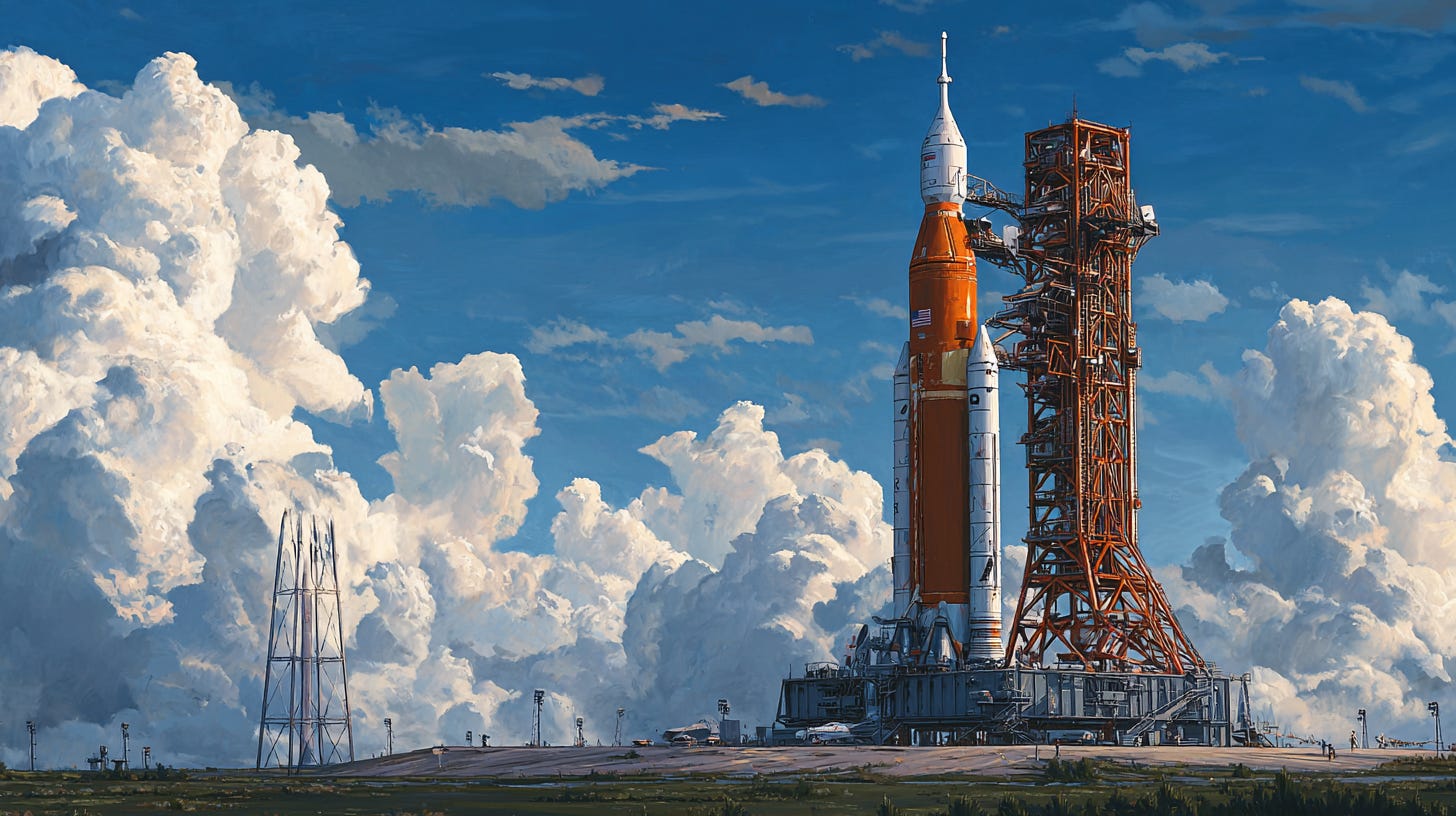
My fellow pro-growth/progress/abundance Up Wingers in the USA and around the world:
I frequently think about a 2019 quote from Elon Musk (this particular version is from a Wired magazine interview, but the SpaceX founder and CEO has expressed nearly identical sentiments elsewhere):
"‘This is the first time in the 4 1/2 billion–year history of Earth that it's been possible to extend life beyond Earth. Before this, it was not possible. How long will this window be open? It may be open for a long time, or it may be open for a short time. I think it would be wise to assume that it is open for a short time. And then let us secure the future, secure the future of consciousness, such that life of the lights of consciousness is not extinguished. And we should try to do this as quickly as possible.”
The part of Musk’s view here that’s typically repeated is the “lights of consciousness” bit, often in a mocking way, to be honest. Too much woo-woo for a CEO, even one in the technology sector.
The part that sticks with me is the question he asks: “How long will this window be open?” Perhaps the answer must be “pretty much forever” and for reasons that have little to do with the fate of consciousness and everything to do with money and military competition. Space is becoming an economic frontier, and America’s most formidable geopolitical rival sees it the same way. When a domain becomes both commercially valuable and strategically contested, great powers do not walk away from it.
The window, in other words, stays open because closing it would be unilateral economic and military disarmament. That certainly wasn’t the case back in the 1970s when America retreated from manned space exploration and limited itself to bopping around in low-earth orbit.
But is American enthusiasm absolute forever and ever, Amen?
An ‘outstanding’ mishap
In June 2024, Boeing’s Starliner launched from Florida carrying two NASA astronauts, Butch Wilmore and Suni Williams, on its first crewed test flight to the International Space Station. Soon after reaching orbit, engineers detected helium leaks in the spacecraft’s propulsion system, followed by a series of thruster failures during the approach to the station. With multiple thrusters offline, Wilmore briefly lost full control of the vehicle and had to manually manage the docking. He was uncertain, meanwhile, whether Starliner still had the ability to perform the critical deorbit burn needed to return safely to Earth.
At one point, Wilmore later said, he feared the crew might not be able to get home at all. Despite this, Boeing initially called the mission “outstanding,” a view NASA publicly echoed at the time. As Ars Technica reporter Eric Berger puts it, “It was, in fact, not outstanding.” NASA has since classified the mission as a “Type A” mishap—the agency’s most serious category—acknowledging that the flight exposed not just hardware flaws but significant lapses in decision-making and risk management at both Boeing and NASA.
Will our current space enthusiasm survive another fatal US space flight? Probably, but it would help if this or (far more likely) some near-future president outlined a broad and long-term vision for Americans and the rest of humanity in space. Musk’s “window” might depend not only on technology or geopolitics but on culture and institutions.
The institutional window
The neat little paper “The View From Pluto: Humanity’s Pathway to a MultiWorld Civilization” by Amos Otungo Ayienda of Eolas Solas Laboratories, a small research organization based in Kisii, Kenya, speaks directly to this issue. Its central argument is that becoming a spacefaring species is not primarily a technological challenge. Humanity already possesses much of the required capability. Reusable launch systems have reduced costs, orbital habitation is routine, and robotic exploration spans the Solar System. The constraint lies instead in whether societies — mostly the US and China, I would think—can sustain a coherent, long-term trajectory.1
The first off-planet domain—the “Achievable Frontier”—includes activities fully consistent with known technological capabilities: permanent lunar operations, local resource production, integrated orbital infrastructure, and early Mars settlement. None require scientific breakthroughs. The gap between what is feasible and what is realized, the author argues, is therefore civilizational rather than technical.
If today’s patterns continue—scattered and unreliable funding, cautious bureaucracies, and one-off missions—progress in space will stay slow and piecemeal. We’ll keep launching impressive projects, such as NASA’s too-pricey Artemis missions, but they won’t add up to a lasting presence. Each mission will stand largely on its own, with little shared infrastructure to build on. Space as a place humanity occasionally visits, not somewhere it actually lives and works.
A different path: Instead of isolated missions, a focus on building the basics of permanence. This means reliable transport, standardized logistics, and infrastructure that grows over time—like power systems, communications networks, and supply depots. The goal would shift from short trips to sustained activity, turning space from a destination into a working environment where humans routinely live and operate.
Beyond the Achievable Frontier lies the “Theoretical Frontier.” This second horizon includes developments that don’t violate established science but demand major advances in energy, materials, and systems integration. Examples include fusion-based propulsion capable of dramatically shortening interplanetary travel times, closed-loop ecological life-support systems that approach true biological self-sufficiency, large-scale rotating habitats generating artificial gravity, and industrial operations in deep space powered by abundant, compact energy sources.
Finally, there’s the “Speculative Frontier,” This realm includes ideas not yet supported by current empirical science but not definitively ruled out by it either—concepts such as spacetime manipulation, radically new energy regimes, or propulsion architectures that exceed today’s theoretical frameworks. This isn’t a roadmap for immediate policy, but a recognition that scientific revolutions repeatedly expand what is considered possible.
The stars our destination
Bottom line: A committed spacefaring civilization doesn’t treat these frontiers as a ladder to be climbed one at a time. Instead, it a) consolidates the first horizon, b) actively pushes into the second, and c) preserves intellectual openness toward the third. As Ayienda puts it, “Progress unfolds not as a sequence of closed chapters, but as overlapping domains of action, inquiry, and imagination.”
In that sense, Musk’s “window” is not a physical constraint but an institutional one. Whether humanity extends its presence beyond Earth depends less on better and better rockets than on resilience: the ability of societies to sustain ambition, tolerate risk, and maintain a coherent long-term vision even when setbacks—inevitable in exploration—occur.
Again, from the paper:
We are the ones with the knowledge to attempt the difficult, the judgement to attempt it wisely, and the privilege of living at a moment when such attempts can matter. If we do not seize this window, it may close for reasons no one intended — through drift rather than decision, hesitation rather than rejection. Not because we’re running out of time in some absolute sense. The Sun will shine for a billion years; the stars will burn for trillions.
But civilizational windows are contingent. The resources, the technology, the political will, the cultural readiness - these align rarely and briefly. We happen to live in one of those moments. But windows, eventually, close; momentum dissipates; societies turn inward. The future we imagine becomes the future that might have been. Tsiolkovsky understood what we have temporarily forgotten: that civilizations define themselves not by their present comfort but by the horizons they choose to pursue. To step forward is not arrogance; it is stewardship. It is the recognition that our moment, like those before it, carries obligations that cannot be delegated. The first frontier of the wider universe lies before us. Its crossing depends on our choice — here, now, together. May that choice be blessed.
Faster, please.
The paper singles out safety culture as a subtle but decisive brake over the past half century. In the early Space Age, risk was understood as inherent to exploration and managed accordingly. Over time, however, institutional attitudes shifted from risk management to risk minimization. High-profile near and actual disasters like Apollo 13 Challenger, and Columbia reinforced this trend. While such caution reduced immediate dangers, it also raised costs, slowed iteration, and discouraged experimentation. The result: Spaceflight became technically safer yet stagnant.
On sale everywhere The Conservative Futurist: How To Create the Sci-Fi World We Were Promised
How long will the windows be open? If there is in fact other intelligent life out there, the fact that we have yet to meet any suggests that the most common answer is, "not long."