✨ How to give a commencement speech about AI without getting booed (too much)
Four pieces of advice for anyone who wants to talk honestly about AI to a skeptical audience

My fellow pro-growth/progress/abundance Up Wingers in America and around the world:
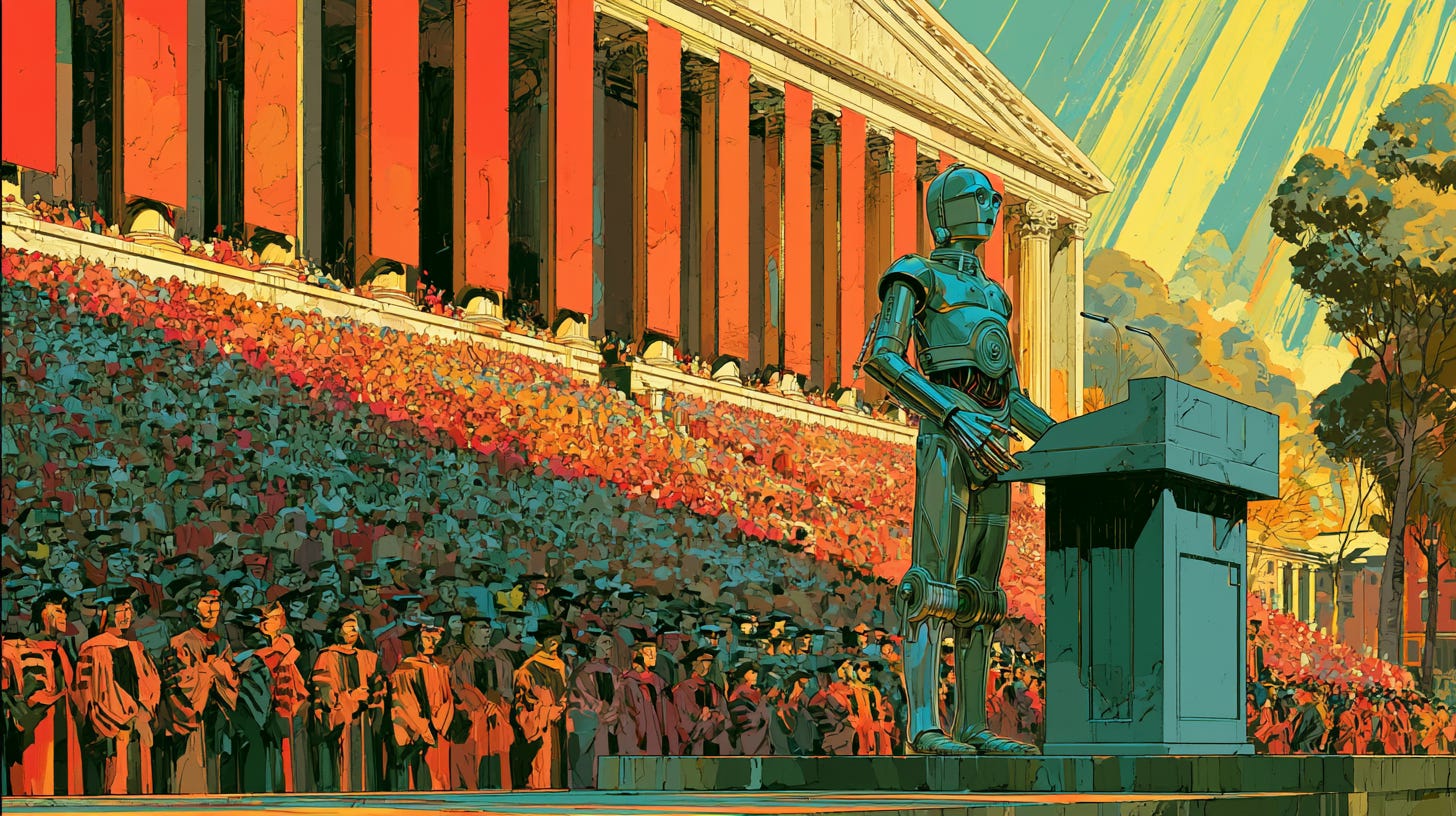
Having attended college graduation ceremonies for five of my seven kids, I guarantee I would’ve preferred ex-Google CEO Eric Schmidt over any of the speakers at those events. Schmidt is deeply involved in artificial intelligence in both the business and government sectors, and the students who booed his mentions of AI at the University of Arizona’s commencement last week instead should have been hyperfocused.
But I don’t entirely blame those boisterous boo birds. While young capitalism haters would have jeered at any Silicon Valley billionaire at any time, a not insignificant number in the crowd were surely concerned that AI will make the job market—and maybe the world—a worse place.
It’s completely understandable. They’ve consumed years of popular culture telling them AI and robots will destroy humanity, and all they have to do is scan the headlines to find executives predicting an AI jobpocalypse starting sooner rather than later. Then there are all those TikTok videos.
So here are four pieces of advice for any commencement speaker who wants to talk about AI:
✨ Give a brief history lesson. AI looks like it will be a powerful, economywide general-purpose technology—”everything’s computer,” basically—but it’s hardly the first. Steam power, electrification, the internal combustion engine, the PC, the internet: what economists call the “Great Inventions.” History’s pattern is consistent: People worry about job disruption, disruption happens, new jobs emerge that nobody predicted. After 250 years of such tumult, we are wealthier and well-employed. That record should inform your baseline forecast about AI’s socioeconomic impacts.
Take the internet. Jeremy Rifkin’s 1994 The End of Work set an anxious tone for the emerging Digital Revolution. Some jobs did collapse—travel agents, where the internet directly substituted for their core tasks.1 But mostly the internet transformed work rather than eliminated it, as outlined in an excellent Wall Street Journal piece from late last year. Dental-lab technicians moved from manual molds to digital scanning. Administrative assistants stopped answering phones and started managing vendors. Today only 10 percent of workers use the internet little or not at all on the job.
Then came the jobs nobody predicted: 65,000 social media managers, 200,000 information-security analysts, and the biggest surprise—warehouse workers and delivery drivers thanks to e-commerce. From 1990 through 2019, real wages of typical workers rose 45 percent, notes my AEI colleague Michael Strain.2 The post-2001 dip in labor force participation is mostly demographic. A repeat of this good outcome with AI is hardly unlikely.
✨ Give a reality check. Forget history, maybe this time is different. After all, CEOs and other executives of the most important American technology companies predicting a white-collar wipeout even as they also predict that AI will produce techno-marvels that drive science fictional increases in productivity and economic growth. But should such fantastical forecasts—sure to grab the attention of potential investors— be your baseline expectation?
Not really. The Forecasting Research Institute recently surveyed more than 500 economists, AI professionals, policy experts, superforecasters, and members of the general public on AI’s likely economic effects. The results tell a more modest story. Both economists and AI professionals put roughly 47 percent odds on a “moderate progress” scenario—one where AI automates substantial work but falls well short of cognitive dominance. Under that most-likely path, neither group is forecasting anything close to a supernova explosion of growth. Economists see real GDP growth near 2.5 percent in the near term, rising to around 2.8 percent by midcentury. AI experts are somewhat more bullish—around three percent by 2030 and closer to four percent by 2050.
The real disagreement surfaces only under the rapid-progress scenario: Economists see long-run growth around 3.5 percent. AI experts see just over five percent. The gap sounds small but compounds dramatically. Yet even five percent growth isn’t unprecedented. The U.S. averaged four percent in the second half of the 1990s. Transformative, perhaps. Science-fictional, no.
✨ Concede this time might be different. Maybe those AI CEOs will eventually be correct. A few experts in the FRI survey forecast double-digit GDP growth. Technologists appear more willing than economists to entertain such tail outcomes. But even a superintelligence must deal with the real world. However dazzling its capabilities, an AI of godlike reasoning power would still have to navigate the stubborn constraints that have always governed how economies actually change.
Benjamin Jones of Northwestern points out that 30 percent annual growth would double living standards every 2.5 years, leaving society a thousand times richer after just twenty-five years. The creative destruction involved would be staggering: rapid turnover in technology, mass obsolescence of skills, entire industries remade before displaced workers finish retraining. Probably a considerable backlash.
Bottlenecks are a related worry. Stanford’s Charles Jones argues that in any system built from complementary parts, the slowest component sets the pace. A superintelligent model could transform coding and scientific research—but if energy infrastructure, physical capital, regulatory approval, and human decision-making keep moving at their usual speeds, those become the ceiling. There’s a gap between raw capability and deployed productivity.
Nor does faster productivity growth automatically produce faster output growth. Dietrich Vollrath of Houston observes that richer societies tend to take gains as time rather than income—shorter weeks, earlier retirements—muting the aggregate effect on GDP even as living standards improve. And as wages rise, spending drifts toward health care, education, and in-person services, where output stays tied to human hours—the Baumol effect—quietly offsetting gains made elsewhere. Superintelligence would be formidable. It wouldn’t necessarily repeal economics.
✨ Outline a better world, and what it costs. Growth isn’t just about accumulating more stuff. Benjamin Friedman, a Harvard economist, spent a career showing that rising living standards correlate with tolerance, civil liberties, and openness to outsiders—and that stagnation reverses all three. The years after 2008 offered proof. The slow crawl out of the Global Financial Crisis fed a zero-sum, populist politics of grievance. AI-driven growth matters because of the society it makes possible when citizens aren’t fighting over a shrinking pie.
It’s also worth recalling what fear has already cost. Nuclear power could have supplied the world with clean, abundant energy decades ago. Instead, public anxiety and regulatory overreach mothballed a generation of nuclear progress. The Apple TV+ drama For All Mankind imagines the road not taken: a sustained space race accelerates fusion power, electric vehicles arrive early, and a fictional James Hansen—the real NASA climate scientist warned Congress about climate change in 1988—testifies that warming has slowed.
Yet the tension is genuine. As Sebastian Mallaby writes in his new book on DeepMind, scientists have always faced a paradox: discovery can destroy jobs, shatter certainties, and in extreme cases imperil existence itself. AI might embody this more fully than any predecessor. Its dangers are real, but so is the promise: medical breakthroughs, climate solutions, tutors of infinite patience. From gunpowder to nuclear fission, technology has repeatedly made the world more dangerous while also extending lifespans and deepening human capability.
A great lesson for new grads: Life is about trade-offs.
As economist Ernie Tedeschi notes, the displacement of travel agents didn’t come during the dot-com boom itself. The 2001 recession triggered a steep decline that never reversed. By 2007, the industry had already shed nearly 40 percent of its peak workforce. Today, travel agency employment is down 60 percent from its high.
Again, Tedeschi: “Average weekly earnings at travel agencies were 87% of overall average weekly earnings back in the heyday of 2000. By 2025, the ratio had reached 99%, meaning travel agency wages had outpaced the rest of the private sector over that span.”
On sale everywhere by James Pethokoukis:
The Conservative Futurist: How To Create the Sci-Fi World We Were Promised