
🛗 How to finance a space elevator
Let's talk about the "Space Value of Money," as outlined in a fascinating new paper


My fellow pro-growth/progress/abundance Up Wingers in America and around the world:
Until recently, the only film or television depiction I had seen of a space elevator was in “Rise,” a 1997 episode of Star Trek: Voyager. Yes, it was pretty cool (as the below image suggests.) As these things go, however, it was a modest example of such a superstructure: a roughly 300-kilometer orbital tether, or cable, linking the surface of an alien planet to a orbital station. Imagine taking a 12-hour journey by maglev cable car to the International Space Station.
Something like that.
Arthur C. Clarke’s classic vision in The Fountains of Paradise was considerably more ambitious. The book’s “orbital tower” anchored on Sri Kanda, a sacred mountain in Clarke’s fictional equatorial island of Taprobane (modeled on Sri Lanka where Clarke lived). Built from fantastically strong “diamond hyperfilament,” the tower would carry passenger cars from the surface to a geostationary satellite roughly 36,000 kilometers above Earth.
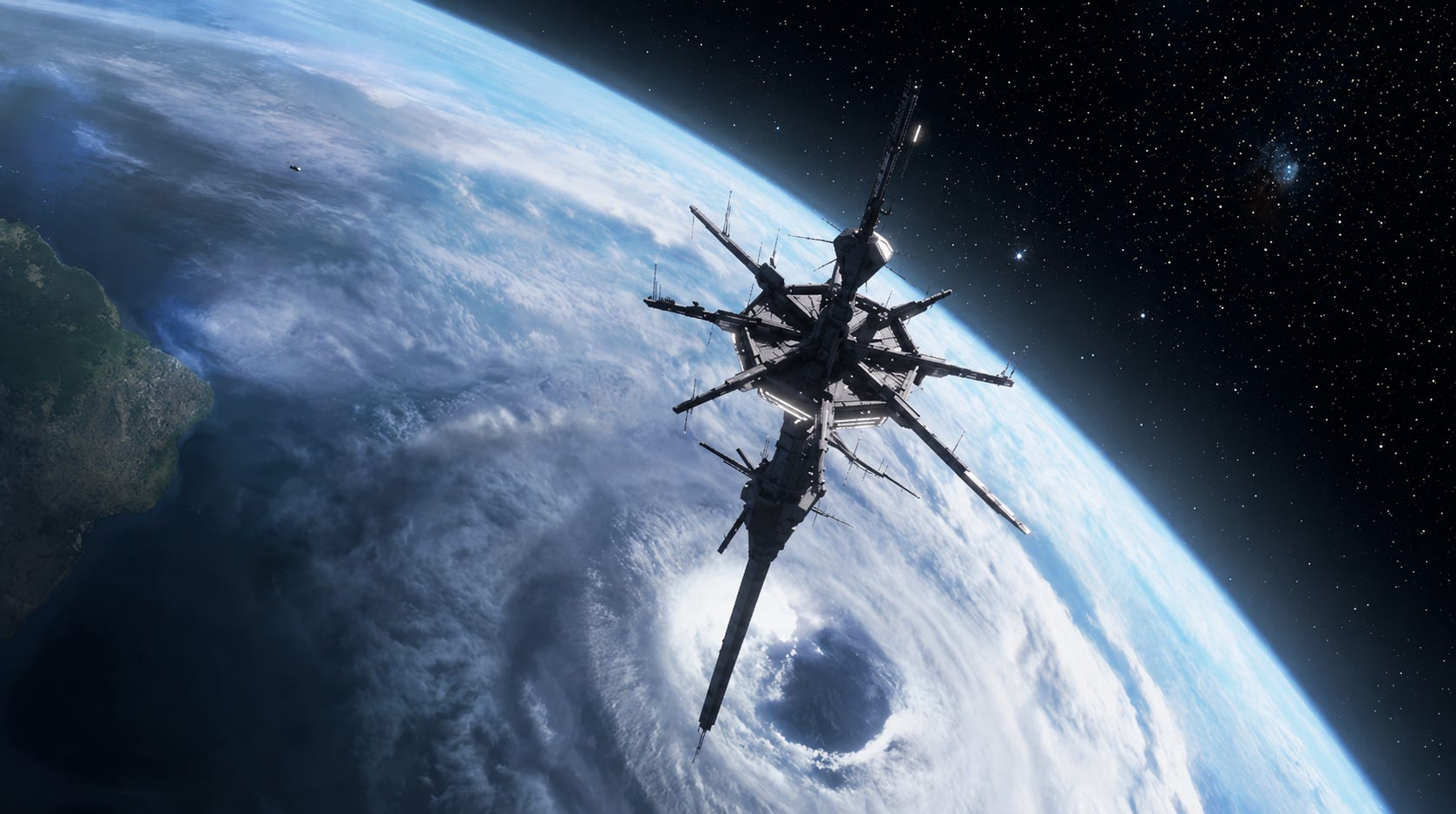
In Apple TV’s Foundation, Star Bridge is a space-elevator megaproject clearly in the tradition of Clarke’s concept. Created for the television adaptation rather than taken from Isaac Asimov’s original novels, the structure links the surface of Trantor to a vast orbital platform in geosynchronous orbit by means of a colossal tether, or “stalk,” that’s some 40,000 kilometers long. To give a sense of scale, if the Star Bridge were—for whatever reason!—to completely collapse the damage would be planetary in nature.
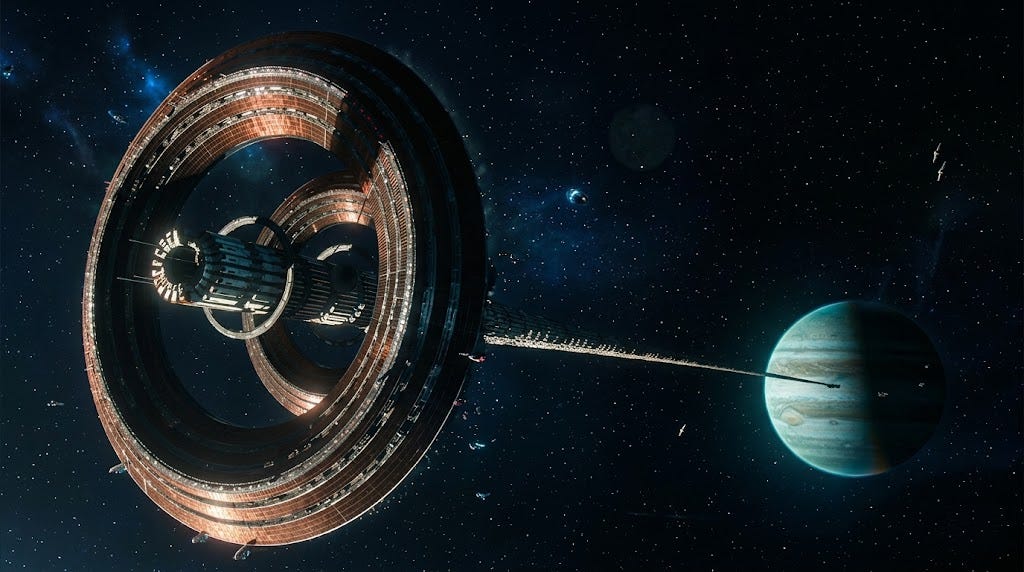
Finally, the just-completed fifth season of (the extraordinarily Up Wing) For All Mankind revolves around construction of a space elevator that would connect Mars with Goldilocks, a captured, iridium-rich asteroid that has become the economic prize at the center of the Red Planet’s future. The show offers lots of nice in-universe, worldbuilding detail, as seen in the following short video:
A space bridge, not a space boat
Let’s start here: Why would a space elevator be worth building, exactly? The basic case is that it turns space access from a series of spectacular one-off launches into permanent off-planet infrastructure—a bridge instead of boats, as enthusiasts like to say. Rather than carrying and burning its own combustible propellant and waiting on weather to be just right, an electric climber ascends a tether to deliver payloads routinely, safely, and far more cheaply. Up and down, no drama.
A second, utterly reasonable question: Can we do this? Even before considering an AI technological kicker, there is definitely a there there.
