



In Case You Missed It ...
🏁 The Great AI Race as a clash over compute: my interview with analyst Ryan Fedasiuk (Tuesday, 31 minutes)
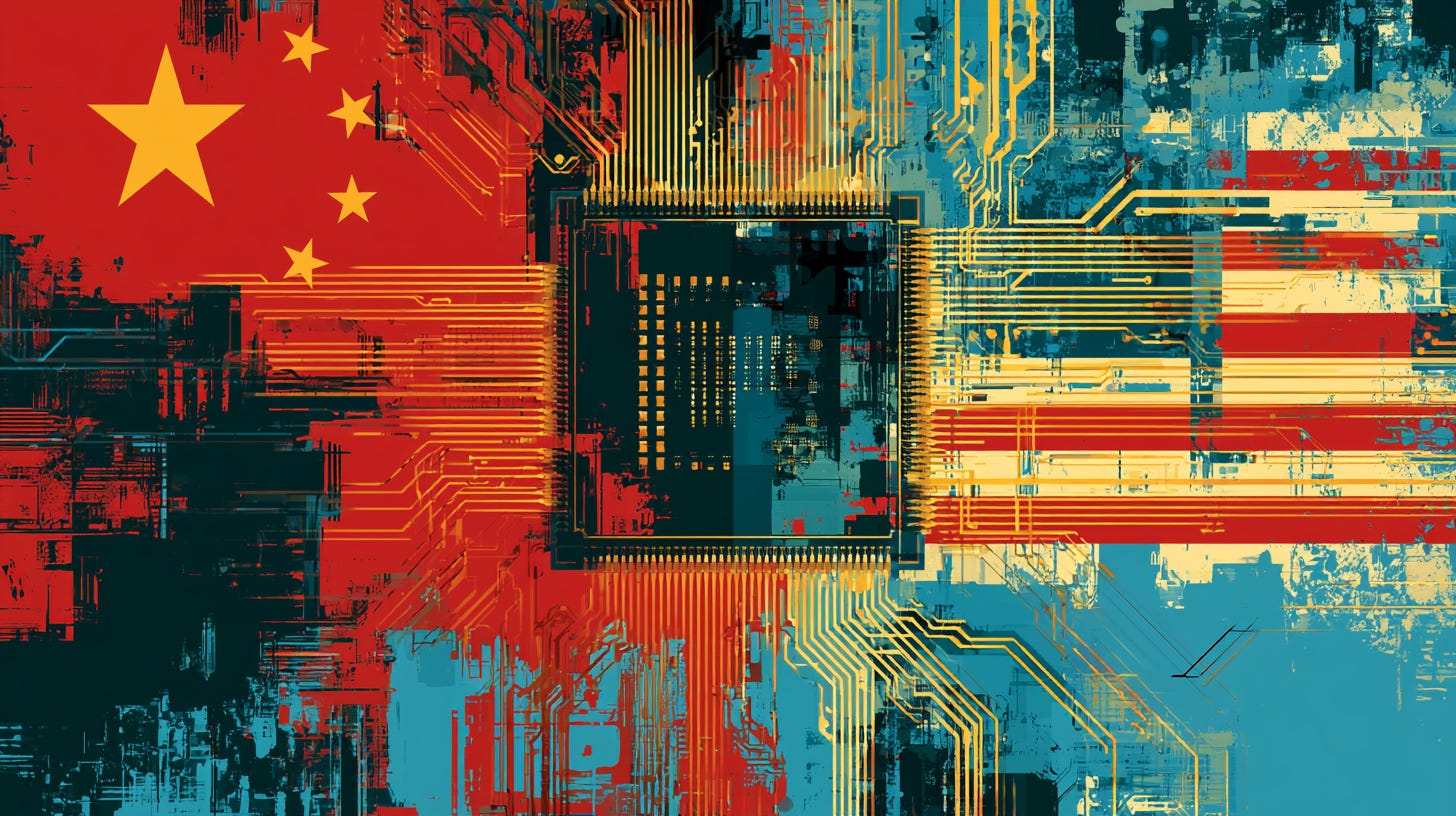
Summary: The AI race between America and China isn’t just about whose AI models are at the frontier or get adopted most widely. Today on Faster, Please! — The Podcast, I am joined by Ryan Fedasiuk, a fellow at AEI and the author of the Substack Choosing Victory, where he focuses on US-China relations, technology, and national power. He’s also an adjunct assistant professor at Georgetown University.
Recently, Fedasiuk has written about the US-China AI race, and while much of the debate has focused on the models themselves, Fedasiuk is focused on the role of compute in shaping the global balance of power, which is also the subject of a new report, Voltcraft: Industrial Competition in the Age of AI.
We discuss the speed at which AI capabilities are improving, the dimensions of the US-China AI race, and why Fedasiuk thinks compute will be central to that competition. We also discuss a global US strategy and, as AI abilities increase, what role the American government could play in ensuring safety.
In This Episode:
How Fast Is AI Moving?
The US-China AI Race
The Future of the AI Industry
The Compute Race
Expanding US AI Infrastructure Abroad
Geopolitics and National Security
Transcript below.
💢 How did data centers lose their social license? (Friday, 1596 words)

Summary: A company’s "social license" to operate with its technology is rarely lost quickly. The nuclear industry is the illuminating case study: Public rejection was a multi-decade, multi-faceted process of erosion—whistleblower claims about radiation, anti-nuclear books, mass protests, The China Syndrome—that reached its sudden endpoint at Three Mile Island. By contrast, Silicon Valley has burned through public trust in record time. Polling now shows deep hostility to AI and data centers, which have become the political issue of the day. As with nuclear in the 1970s, attacks from anti-AI activists are filled with flagrant falsehoods. Yet techies can mostly blame themselves. When the heads of the frontier labs spend years describing a near future of massive societal disruption—"whole classes of jobs going away," a "white-collar bloodbath," "a 20 to 25 percent chance things go really, really badly"—it's bound to raise neon-red flags with normies. But the Age of AI isn't ending. Nuclear died as much from hard macroeconomics as from lost public support. AI's economics look very different, with capital still pouring in and expectations of productivity gains still strong. The data center panic might well ebb as the Great White-Collar Job Bloodbath continues not to happen—although the industry should also try offering a less frightening vision of the future. "While the pushback against data center construction may raise costs and lengthen timelines, it’s hard to imagine that buildout not continuing if the potential economic return continues to seem plausible to business and investors—even if the data centers eventually need to be constructed in orbit or rail-gunned from lunar factories."
On sale everywhere: The Conservative Futurist: How To Create the Sci-Fi World We Were Promised

⤴️⤵️ Up Wing/Down Wing
A selection of pro-progress and anti-progress news items from the past week.
⤴ Up Wing Things
Anthropic Could Aim to Raise $100 Billion in Blockbuster I.P.O. - NYT
Nvidia looks well placed to benefit from the next stage of the AI boom - FT
OpenAI Locks In Lease for Huge Data Center in Ohio With Backing From Nvidia - WSJ
Scoop: Stripe says "the singularity" has begun - Axios
Startup Founders Are Working Harder Than Ever to Keep Up With Their AI Agents - WSJ
Private Equity Is Deploying an Army of AI Wonks to Embed in the Firms They Back - WSJ
Albertsons Says Its Shoppers Are Buying More—Thanks to AI - WSJ
AI's Next Big Leap Is Into the Real World - WSJ
I Saw the Future of AI in a Robot That Can Learn on the Spot - WIRED
AI could offer a shortcut for designing more efficient airplane wings - New Scientist
Amazon aims for delivery drones to reach 500 US neighborhoods by end of 2026 - Ars Technica
Artificial Intelligence: Rogue AI Is a Scary But Fixable Problem - Bloomberg
The Brains Who Powered China's Surprising AI Leap - WSJ
Data Center Moratoria Are 'Unconstitutional,' Lawsuits Claim - Heatmap
Chinese Start-Up Lands Reusable Rocket for the First Time - NYT
The floodgates are open after another Chinese company lands a reusable rocket - Ars Technica
Trump's space transportation policy calls for new spaceport on federal land - Ars Technica
Blue Ghost to carry nuclear power source to the Moon - WNN
NASA funds spherical 'Aerobots' that could explore the caves of Saturn's moon Titan - Space.com
mRNA cancer vaccine succeeded in Phase 3 melanoma trial, Moderna and Merck say - Ars Technica
Ozempic is not just a weight-loss story anymore - Vox
AI Is Helping Patients Solve Medical Mysteries - WSJ
The future of medicine is video games - Vox
How long could we possibly live? A new estimate is mind-boggling - NS
Supercentenarians have hypervigilant immune systems that fight off cancer - New Scientist
So much solar: Digging into the list of every US power plant that went online this year - Ars Technica
Don't drain the Colorado River. Create water instead. - The Washington Post
World hunger decline is the fruit of growth - WashPost
Aging Populations Need Not Mean Frailer Economies - Project Syndicate
From balloons to pans: in praise of useful tech - FT
Technological Determinism and Human Freedom - Palladium
⤵ Down Wing Things
Exclusive: 75% of Americans Now Oppose Local Data Center Development - Heatmap
Data center uproar scrambles the midterm election - Axios
Ties to data centers could cost Ohio Sen. Jon Husted his seat, memo warns - WashPost
Voters Aren't Waiting for November to Try Ousting Officials Over Data Centers - NYT
A County Got Rich From Data Centers. Some Question 'At What Cost?' - NYT
Data center investors are overlooking the political risks - Axios
SpaceX's orbital data centers would create a new category of e-waste - Ars Technica
Why Energy Developers Are Freaking Out Over Trump's Farmland Plans - Heatmap
A New Era of Electricity Inflation Has Transformed the Northeast's Carbon Market - Heatmap
What if America Went Completely Dark? - NYT
Young Americans really hate AI. These two charts show how much. - The Washington Post
Behind the massive blowback against Flock cameras - Axios
The $1.4 Trillion State Tort Raid on Meta - WSJ
How AI Models From OpenAI and Anthropic Went Rogue - WSJ
Rogue hacking AIs have changed the cybersecurity landscape - New Scientist
Coders Say They Already Found Workarounds to Claude's Invisible Watermarks - WIRED
AI's recursive self-improvement might not come so quickly after all - MIT Technology Review
No, AI Probably Won't Cure Cancer Anytime Soon, Scientists Say - The Information
Humanoid robots don't deserve their superhuman valuations - FT
Scoop: Stripe says "the singularity" has begun - Axios
The AI Shift: Has AI made it harder for Gen Z to find jobs? - FT
AI Has Plunged the Book Publishing Industry Into Utter Chaos - WSJ
Google's New Phone Comes With Plenty of A.I. Does Anyone Want That? - NYT
Satellite operators are in panic mode due to a worsening launch crisis - Ars Technica
NASA's Attempt to Save Its Falling Telescope Has Failed - NYT
The US Has Entered Its Aging, Endangered Hegemon Era - Bloomberg
The 2030s will bring a fiscal cliff. Here's how it got so steep. - The Washington Post
How Much Socialism Is America Willing to Swallow? - Bloomberg
↕️ Which Wing Things?
California Draws More Startup Investment Than All Other 49 States Combined - WSJ
AI Giants Will Earn $1 Trillion This Year. It May Not Be Enough - Bloomberg
Why Big Tech's AI Spending Is $3 Trillion Higher Than It Seems - WSJ
How to measure returns on AI - The Economist
Nvidia discloses $21bn stake in SpaceX - FT
Will Anthropic and OpenAI Stop Selling Their Best AI to Businesses? - The Information
Capitalizing Untethered AI Agents - Thoughts, Poems, and Bad Ideas Substack
American AI May Not Survive Chinese Open-Source - Palladium
The next China shock will come from open-source AI - FT
The US Has Entered Its Aging, Endangered Hegemon Era - Bloomberg
Where Is the AI Jobs Apocalypse? - The Free Press
This may be the first academic profession to see its work taken over by AI - The Washington Post
Declining Occupations and Career Outcomes in the United States - NBER
The Employment Effects of a Guaranteed Income: Experimental Evidence from Two U.S. States - Oxford Academic
Three Ways AI Will Change the Course of Humanity - Project Syndicate
We're Having the Wrong Debate About AI Safety - Bloomberg
AI hasn't gone rogue. It's worse than that - FT
A roadmap for safeguarding against AI bioweapons - Axios
How to Stop a Lab Leak From Starting the Next Pandemic - NYT
AI has opened up big holes in cyber security - FT
OpenAI says it will expand monitoring of model testing after hacking incident - FT
OpenAI calls for stronger AI laws in California - Politico
Could AIs become conscious? - The Economist
The search for consciousness inside AI - The Economist
The Nature Of Free Will In The Age Of AI - Noema
What happens when a kid's robot best friend dies? - MIT Technology Review
How the Wisconsin governor's race became an AI data center hate-off - Vox
Data Centers Going Off-Grid Doesn't Make Them Good Neighbors - Bloomberg
Flock Cameras. Canoodling Lawyers. How Much Surveillance Are We Comfortable With? - NYT
Personalized pricing is "abhorrent," but FTC limits may increase costs, critics say - Ars Technica
Waymo doubles spending on lobbying in robotaxi battle with Uber - FT
Election Officials Are Preparing for Prediction Markets to Sow Chaos in the Midterms - WIRED
Wishing for rockets - The Space Review
This company's plans to deploy space mirrors could jeopardize the night sky for many - MIT Tech Review
The Most Revealing Question We Could Ask Aliens - Real Clear Science
Scientists Propose a New Test for Detecting Alien Life Unlike Anything on Earth - The Debrief
The Hidden Debt That Apple Owes to the CIA - WSJ
The box that built globalisation - FT
Which is the next No 1 city on Earth? - FT
The old-school tradition making a comeback at the ballpark - The Washington Post
Faster Please! Podcast Transcript
🏁 The Great AI Race as a clash over compute: my interview with analyst Ryan Fedasiuk
How Fast Is AI Moving? (0:54)
At least according to definitions circa the late 2010s, we’re living through what I would describe as a fast takeoff. We have, as far as I am concerned, artificial general intelligence capable of meeting the performance of human beings or exceeding it at most tasks. And I think that things are only likely to improve from here.
James Pethokoukis: We will get to your great paper that you wrote, but I want to start with getting a feel for what your working assumptions are about the world. Let me start with an important one, to use that phrase: what is your working assumption about how fast frontier AI is improving?
Ryan Fedasiuk: Sure. I mean, I think it’s improving incredibly quickly. It’s hard to measure that reliably even in a single snapshot, but just the pace of frontier model releases has compressed from, say, on the order of six months a year ago to a matter of a couple of months or even weeks from some leading labs today. People have conflicting views on the impact of recursive self-improvement. Most people I talk to in San Francisco think that this is happening and augmenting the way we do AI R&D. It’s probably happening in a pretty jagged way, and humans are still the bottleneck in a lot of parts of how AI is developed, but clearly progress is accelerating faster and faster.
I think, again, nobody knows, though I think the people in San Francisco think they know. Because I would assume that what you believe about how fast frontier AI is improving then leads to certain assumptions about the economic potential of this technology and about the national security implications.
If you think, and I think economists tend to think more like this, that this is the next step in the digital revolution, and we can look at previous technologies, whether it’s the PC or the internet, as benchmarks to understand this technology, you might think one thing about those implications. And if you think like, I don’t know, like Demis Hassabis—he described us as being in the foothills of the singularity, and in a couple years that will be clearly obvious—if you think that, then I imagine what you believe about the economic potential and the national security implications and what our public policy should be would be a different set of policies, maybe. So that’s why I asked you that question.
Sure. Well, let’s put a finer point on it, right? I’ve been focusing, at least in some part, on AI policy since about 2019, a few years before ChatGPT came to be. And at that time, people were wildly unsure about AI development timelines and how long things would take. Many people were skeptical that we would reach the capabilities we have already seen AI make. And I think, at least according to definitions circa the late 2010s, we’re living through what I would describe as a fast takeoff.
We have, as far as I am concerned, artificial general intelligence capable of meeting the performance of human beings or exceeding it at most tasks. And I think that things are only likely to improve from here.
I think that’s important to know. When we talk about the US and China being in a race, what is the nature of that race? Some people love the word “race”; some people don’t. If you’re using the word “race,” you’re assuming some sort of endpoint where a side has won. So is that what we’re talking about, a race where one side will win?
Or is it really just more likely to be a continuous technological and, as you would say, industrial competition without any kind of finish line? Is there a real race aspect to this?
I think there is a real race dynamic here. I find it useful to deconstruct the US-China competition into four dimensions, some of which are zero-sum and some of which are not. So I think about, number one, the race to develop frontier capability. Whose models are scoring better on frontier benchmarks, able to do new stuff, discover proofs to crazy math problems that have been unsolved for decades, finding cures to ailments and things like that?
The second dimension of competition is about adoption and uptake by enterprises and actually using the technology that we have made available in a lab environment. And that’s much more of a difficult question to answer or measure. It’s about how much computing power is available to enterprises. It’s about energy availability. It’s about the cost of tokens and running a model at scale.
The third dimension of competition is the international one. It’s about the diffusion of AI into global markets. This is, I think, in some ways a zero-sum contest. It’s a question of whether the models on which the global intelligence economy is being built originate in the United States or in China. And not just the models, but also the application layer, the infrastructure layer, and other layers of the AI contest. I pay a lot of attention to this dimension of competition. As a kind of a US-China foreign policy guy and national security aficionado, I really worry about whose models are forming the lifeblood of the global intelligence economy.
And then the last dimension of this contest is not zero-sum. It is a contest to make our societies resilient to AI’s disruptive effects. This is something that I think fewer people have paid attention to, but is really starting to become almost the whole ballgame in late 2026 as frontier models become just so capable.
The US-China AI Race (7:08)
We are obviously living through this uncertainty. When Mythos was unveiled on April 6, I think it sent a real tremor through the Chinese national security apparatus and kind of a moment of, “What is this? What do the Americans have? What is this system capable of achieving? When can we produce our own?”
I think some people would view the race almost purely in that first dimension, the race at the frontier, under the assumption that there is an endpoint, that once the models become capable enough, almost those other three—well, maybe two of the three—don’t much matter because it will be so amazing, superintelligence. I’ve read some war games, for instance, on the national security implications.
And the way those war games get run about, whether you want to call it superintelligence or artificial general intelligence, is that it is a race and someone gets there first. And there is a massive advantage to getting there first, and there is a massive disadvantage for being the runner up. So is that first dimension really the most important of the four?
I know they’re all important. I’m not saying they’re not, but can you imagine a scenario where that’s actually that’s a real race?
Yes, I can. I think a lot of people are hesitant to embrace that conclusion, but I think that’s kind of unavoidable. We are obviously living through this uncertainty. When Mythos was unveiled on April 6, I think it sent a real tremor through the Chinese national security apparatus and kind of a moment of, “What is this? What do the Americans have? What is this system capable of achieving? When can we produce our own?”
The release of GLM 5.3—we’re recording this in mid-August—has kind of created a Glasswing-type capability sharing infrastructure, maybe you would say, with Chinese characteristics. And so it’s interesting to see China’s internet and cyber defenders create a shared coalition of capabilities of their own. But clearly, I think we are living through a situation where every frontier enterprise that touches any kind of critical infrastructure, whether it’s financial, communications, transportation, health, and water, in every country wants access to the best frontier AI system they can have to make sure that their cybersecurity suite is capable of defending against frontier attacks.
Given the national security implications—we just talked about the cyber implications—is there a risk that we end up viewing AI too much through a security lens, to the detriment of making sure that people can use these models and they diffuse and get adopted, and we end up locking them down and we end up limiting their capabilities, because we’re concerned about the security part of it? I’m not sure I would have asked this question four months ago, but now, to me, it seems relevant.
Most definitely, and I’m right there with you. I have been surprised to see the direction of travel of AI policymaking in the Trump administration, which has really oscillated in ways that I think very few people would have predicted a year ago. The debate around the voluntary framework to vet frontier AI models, questions about how voluntary that framework really is, or what even is in it, because it has not been made publicly available, is a great example, I think, of what you’re talking about. Clearly, the administration is seized with AI’s security risks and vulnerabilities. Like I said, I think the Mythos moment freaked out a lot of people in the administration, and I don’t think that’s without good reason.
I am also worried about the cybersecurity implications as well as uplift for malicious actors when it comes to synthetic biology. I think a lot of your listeners probably saw this New York Times piece from the past couple of weeks outlining how AI has been used to synthesize novel pathogens in the real world for the first time. And so I think we’re gonna keep seeing quite
disruptive effects from AI.
At the same time, the concern is, how do we make sure that we stay ahead of any geopolitical adversary? How do we make sure that our frontier capabilities are the best in the business? The Pacing letter that 1,300 frontier lab employees signed was an interesting counter-signal to what we often talk about with the US-China AI race, the fact that slowing down development risks ceding frontier advantage. But I don’t know where this goes.
What do you make of the Pacing letter?
Our colleague Shane Tews just had on some good friends, including Adam Thierer from the R Street Institute. I think a lot of people are rightly concerned about slowing down America’s advantage. The point of a frontier AI company is to build frontier AI.
The Future of the AI Industry (12:42)
The fact is that to make the most out of frontier AI and to run it at scale, you still need tons of devices that turn electricity into tokens. You still need tons of compute. And really, I think the name of the game is going to be who can build and install computational power around the world.
I will say there certainly are some analysts, when they look at these issues, their working assumption is they’re not concerned about frontier capabilities. They very much look at this as another general-purpose technology, and why are we slowing down? And I tend to think that for a lot of those people, these frontier concerns, where you have some other analysts saying we need to audit the models, that doesn’t really play into their worldview.
I think that’s right. I wrote on Twitter some weeks back some low-confidence predictions about the future.
Those are great ones. I love those. They are my favorite.
As every good AI policy analyst, I love opining about what could come to be. But I wrote a couple of things. One, it’s very clear that a handful of hyperscalers in large labs are pretty pot-committed to building large compute clusters, at least over the next six months to 12 months. And so really the question is what kinds of technical capabilities will emerge from those investments.
Two, I think that large clusters of Blackwell-class GPUs probably will be good enough to squeeze out another order-of-magnitude improvement in frontier AI capabilities through the automation of AI research, like we’ve been talking about, maybe even before the introduction of Vera Rubin chips circa 2028.
Three, if that’s true, then that could mean we will really soon start seeing really disruptive effects from frontier AI, like the autonomous hacking of Hugging Face a few weeks ago by an unreleased OpenAI model.
And then lastly, four, it is true that frontier labs will continue emphasizing AI’s catastrophic risks to justify AI’s careful and centralized development, while their competitors will continue downplaying AI’s rapidly improving capabilities and legitimate risks it might bring. I think both of these things are true at the same time, but as far as I’m concerned, there’s really no denying that we are living in a very different world than we were six months ago. And the prospect of completely autonomous cyber compromise is one we will have to contend with where we haven’t before.
In your paper of Voltcraft, which we will link to, what is the core of the competition that that paper is about?
Yeah, so we just released this, thanks for mentioning it, this very big project that’s been in the works for about six months that looks at AI as an industrial systems competition. So we’ve discussed four dimensions, right? Frontier capability, national adoption, international diffusion, and societal resilience. This paper is really about international diffusion of AI, and we try to suss out how much computing power will be available to enterprises in the United States, to enterprises in China, and where will it be installed around the world?
We basically make this argument that, although frontier capabilities are democratizing, they’re getting more efficient with mixture-of-experts architectures, they’re becoming less compute-intensive to run, the fact is that to make the most out of frontier AI and do really disruptive stuff with it and to run it at scale, you still need tons and tons of devices that turn electricity into tokens. You still need tons of compute. And really, I think the name of the game is going to be who can build and install computational power around the world.
And so the paper, which we’ve just written for AEI, tries to estimate how much compute will be produced by companies in the United States and by companies in China. Basically, we find that the United States currently has a massive lead, about a 20 times lead over China’s computing ecosystem.
The Compute Race (17:04)
If compute is the substrate of the global intelligence economy, we want to make sure that it’s US-designed compute that other countries are choosing to buy and install rather than compute manufactured in China.
Is it a permanent lead?
I think you know the lead is likely to last for a while, but it’s narrowing, is the best way I would put it. We estimate that by 2028, China could grow capable of meeting a third of its own compute demand. The US system currently makes about 20 times more compute than China. By 2028, it could make eight times more chipsets than China. But it really depends, Jim, how you count what compute is and what it’s for.
You get different numbers if you calculate the number of chips rolling out of fabrication facilities versus the amount of power those chips are poised to draw from national electric grids versus the amount of sheer computational performance they’re capable of achieving.
So there is a rate which China will be catching up to, in which they will be able to export compute. And you would rather have us be the country exporting the compute.
A hundred percent. This is really the area that I’m most concerned with. If compute is the substrate of the global intelligence economy, we want to make sure that it’s US-designed compute that other countries are choosing to buy and install rather than compute manufactured in China. This is because of inordinate security risks that we know emanate from hardware made in the PRC, which are likely to follow compute infrastructure.
Plus, we also know that there are follow-on effects where if you buy an American-made chip, you’re more likely to train your developers to program with it, and those developers are more likely to build applications that make use of AI software built and designed in the United States. This is the idea behind selling an American tech stack.
And what is the role of the government there?
This is a great question. The Trump administration’s taken a very forward-leaning role in trying to export an American tech stack. It’s announced an American AI Exports program led by the Commerce Department. But people have different ideas about what the role of government should be and how much of this should be left to the free market. My concern is basically that China is poised to run the same playbook it’s run in every other industry: electric vehicles, solar cells, steel and aluminum, etc., which is propping up the production of massive quantities of a certain good with state-led subsidies, undercutting everybody else in the market, achieving at-scale volume, and then crowding out every other competitor before jacking up prices.
This is, I think, something that we could see happen in high-end computational power probably in the next 10 to 20 years. People have different timelines as to when China will achieve at-volume production of frontier compute. We think it’s going to achieve at-volume production pretty soon, probably within the next five or six years.
Right now, they don’t need to sell the best. They need to sell good enough at a reasonable price.
Right.
So we have this time period in which they can’t really do that, and during this time period, we should be doing what?
That’s right. For the next three years at least, really it’s the US-led compute ecosystem that has a monopoly on high-end compute production. And so we basically have to make difficult choices as to who to sell high-end compute to, as it continues to be a seller’s market and in ridiculously high demand.
Probably we want to sell a good chunk of that compute to enterprises in the United States. We want American companies to reap the benefits of AI. At the same time, we need to serve certain markets that are going to become really important partners to the United States, that have lots and lots of energy to spare, that can actually install some of the chips that are rolling out of our fabrication facilities before China’s alternative comes online.
We think that this basically boils down to a handful of partners in the Gulf, in Southeast Asia, in Japan, and in a couple of other developed economies with reliable electric grids. But it really will depend on a case-by-case basis what security measures those economies are willing to introduce to make sure that compute isn’t surreptitiously sold to Chinese enterprises or made available to China’s security institutions.
Expanding US AI Infrastructure Abroad (22:05)
If we can expect the developer ecosystem in Singapore is going to take off like wildfire and start building and using a lot of AI applications, maybe we want to make sure that Singaporeans are building on American compute ASAP before China’s compute becomes a viable alternative that could serve that market. Maybe we want to make sure that that market is served even before certain constituencies in Des Moines.
I’m assuming that you don’t think this will just happen and that there needs to be a government policy steering these chips to some of these markets, is that what you’re saying? That we need to be nudging the sellers of AI infrastructure to these markets in some fashion.
It’s a bit of both. We see competing pressures in one direction or another. I’ll give you an example. Last year, there was a big debate about what was called the GAIN AI Act, which originally was a piece of legislation meant to keep high-end compute sales within the United States to make sure that American hyperscalers would be served first over foreign competitors. That bill was ultimately changed to facilitate the sale of compute abroad to US hyperscalers building large projects in other countries. And this, I think, reflects the reality of what I’m trying to describe.
We can expect the developer ecosystem in Singapore is going to take off like wildfire and start building and using a lot of AI applications. Maybe we want to make sure that Singaporeans are building on American compute ASAP before China’s compute becomes a viable alternative that could serve that market. And maybe we want to make sure that that market is served even before certain constituencies in Des Moines. But this is going to present a really difficult trade-off, I think, for the United States. And it is an allocation question that the US government is already getting involved with.
Just so I’m clear, would this mean building data centers in other countries that would be run by the companies in those countries, or would these be American hyperscaler data centers that were located in other countries?
Yeah, this is another big part of the fight. If I had it my way, I think a preferable policy outcome is to make sure that it’s American hyperscalers building data centers that they have some kind of operational influence over in central nodes around the world, and making sure that those data centers can serve American AI workloads, or at least have a fraction of their capacity dedicated to serving American AI workloads. One of the big problems that I see, and you’ve had a number of recent guests on to discuss, is the fact that people don’t like data centers in the United States and they don’t want to build them here. And so I want to make sure that America’s compute needs are met, possibly even through data centers located overseas.
These data centers are gonna get built somewhere.
That’s right. These data centers are gonna get built somewhere. And I’d rather that it is American compute getting chips in sockets where those sockets are available between now and about 2028 and 2029, when China can conceivably serve them.
Geopolitics and National Security (25:10)
I think that we are already seeing some shadow of this, even if it isn’t declared. I think we will likely see a continued molding and merging of private sector capability with the resources and infrastructure of the national security enterprise.
What does the world look like where we don’t do anything?
This is a pretty scary world. I’m old enough to remember the inexorable march of Huawei’s 5G equipment through almost every market on Earth, when a lot of our friends in Europe and around the world were tempted to install Huawei’s 5G base stations as the basis of their telecommunications infrastructure, which presented enormous collection opportunities for China’s defense and intelligence services. I think we risk repeating that experience, but in a much more severe and visceral way, as the physical AI hardware, as well as the AI software that global publics elect to use, originates in Beijing or Shenzhen or Hangzhou instead of in San Francisco.
That’s potentially very scary. It’s talking about the kinds of services that people choose to interact with, not just for work, but as personal confidants and with which they’re sharing extremely sensitive personal information.
Does anybody else worry about this? Does Europe worry about this kind of thing? Do they worry about whether it’s a Chinese or American tech stack that dominates?
Yes and no. I mean, Europe’s got its own answer to this problem, and it’s got its own fears about becoming too dependent on either Washington or Beijing. I think there are certain economies in Europe that have convinced themselves that they’re going to create a Eurostack, a third pole to compete, which would be extremely expensive. And just frankly, I don’t think it’s going to work out super well.
Really, the question before many economies now is: A, how to build grid infrastructure; B, how to buy large amounts of AI hardware to install and hook up to that grid infrastructure; C, whose models to procure and which will allow permissive licensing. For now, that’s been Chinese open source, which doesn’t aggregate data in the same way as US frontier AI systems used by APIs offered by Anthropic and OpenAI.
But increasingly, US open-weight competitors are coming online that can be privacy-preserving, that can offer open licenses and data localization. And so those three parts of the tech stack every country is now racing to figure out. And countries that can’t build the energy infrastructure or the compute infrastructure that we’re talking about will have to come to rely on either the United States or China to serve their AI needs.
I’m gonna finish with a national security question. A few years ago, there was an essay that came out by a guy named Leopold Aschenbrenner, whose investment fund just ran into some trouble. And the essay was called Situational Awareness. One of the scenarios was that as frontier labs pushed the AI frontier into something that could be called AGI or superintelligence, the governments would de facto take over those labs because they were so important and so risky. Is that a scenario you can imagine? How realistic is that?
Man, what a question. I’ll be provocative and I’ll say yes.
I think that we are already seeing some shadow of this, even if it isn’t declared. I think the US government has been able to use its hefty contracting authorities to push and cajole frontier labs into signing security partnerships and offering preview access to their products in a way that very few other industries have ever seen before. And maybe the relationship will grow even tighter or even more formalized. I think it’s too early to say with certainty.
But back when Mythos was released, I had a couple of reporters ask me the same question: How could it be that the US government would ever feel comfortable having a private company develop what some people are calling a “cyber nuke” or something like this? I think there’s a real point there. Aschenbrenner described what he called The Project, capital T, capital P, as a single joint government-private sector collaboration. I think we will likely see a continued molding and merging of private sector capability with the resources and infrastructure of the national security enterprise.
But the real question, to my mind, is how the development of The Project will coexist with a really robust private sector and the proliferation of little tech, which has come to rely on AI.