⚛️ A nuclear step forward—maybe
Also: In defense of the data center: A quick Q&A with … Reason's Christian Britschgi

My fellow pro-growth/progress/abundance Up Wingers in the USA and around the world:
America may finally be building a new kind of nuclear reactor. TerraPower, the company founded by Bill Gates, has received federal approval to begin construction on its Natrium plant in Wyoming—the first new US commercial reactor project to clear that hurdle in nearly a decade (and the first approval for a non-light water reactor in more than 40 years.) The plant, a 345-megawatt sodium-cooled reactor paired with molten-salt energy storage, is expected to begin operating around 2031.
For advocates of nuclear power (like me), the milestone is most welcome. The context, of course, is a surge in electricity demand. After roughly two decades of stagnant consumption, US power use is rising again as artificial-intelligence data centers, electric vehicles, and electrified heating spread through the economy. Some estimates suggest AI infrastructure alone could require roughly 30.5 gigawatts of new power—equivalent to about 90 TerraPower-sized reactors.
Small modular reactors, or SMRs, are supposed to help fill that gap. Their pitch is simple: build smaller reactors in factories, assemble them on site, and replicate them at scale. TerraPower hopes its design will eventually generate electricity far more cheaply than traditional nuclear plants. The company’s first unit, however, is expected to cost roughly $4bn.
That price tag highlights the central uncertainty. As Michael Cembalest of JPMorgan argues in a new energy report, the economics of SMRs remain largely unproven.
The basic calculation is conceptually straightforward: Can SMRs produce electricity cheaply enough to compete with other power sources? A reasonable benchmark might be around $125–$130 per megawatt-hour. Modern gas plants, by comparison, can generate electricity for roughly $55–$85 per megawatt-hour depending on fuel costs and financing.
SMRs face a structural problem, as Cembalest points out. Traditional reactors grew larger over time—often around 1,000 megawatts—because spreading enormous construction costs across more electricity reduces costs per unit. SMRs reverse that logic. Smaller reactors risk losing those economies of scale unless mass manufacturing eventually drives costs down.
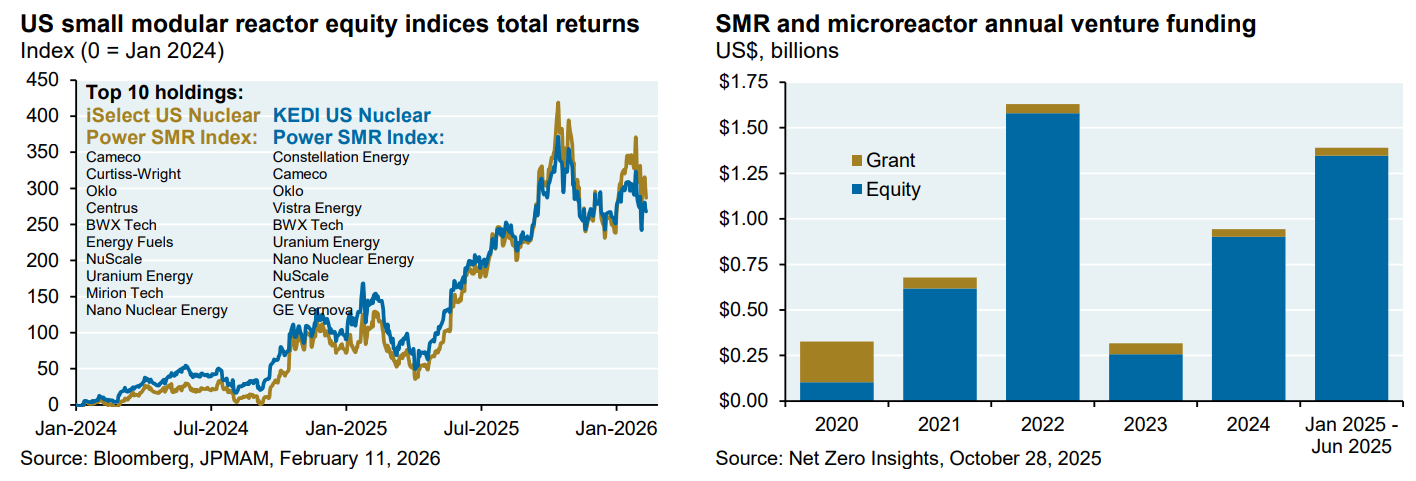
Early estimates suggest the challenge is real. Some studies place SMR electricity costs between $200 and $400 per megawatt-hour, while analyses by the Tennessee Valley Authority estimate first-of-a-kind reactors near $196 per megawatt-hour, falling perhaps to $150 if construction costs decline.
None of this means SMRs are no better than some energy wildcard. Reliable, carbon-free power that runs around the clock would be extremely valuable in a grid increasingly dominated by intermittent wind and solar. Early markets could include remote grids, industrial facilities, data centers, and sites replacing retiring coal plants, according to JPM, which concludes, “With enough money, time and regulatory approvals, SMRs can certainly be built.”
But that outcome is not guaranteed. TerraPower’s Wyoming project is best understood as an energy experiment. The real verdict on SMRs will not come when the first reactor is approved—but when the tenth is built, as the company’s CEO conceded to The New York Times.
In the meantime, according to the report, America will meet rising electricity demand largely with the technologies already at hand. Solar now accounts for roughly two-thirds of new generating capacity additions, while batteries smooth daily fluctuations. Yet reliability will continue to depend heavily on natural-gas plants that can run whenever the grid requires them.
A key point: This isn’t a report that assumes any big innovation such as widespread geothermal or nuclear fusion, as intriguing as their potential is. Most important over the coming decade: building generation, transmission lines, and grid equipment fast enough to power an economy that will need cleaner and more abundant energy.
Are you listening, Washington?
⚡✨ In Defense of the Data Center: A Quick Q&A with … reporter Christian Britschgi
Data centers have been getting a bad rap these days. In communities where data center construction has been proposed, NIMBY concerns range from water overconsumption to rising electricity bills to the degradation of local character.
Policy reporter Christian Britschgi, however, would like to dispel many of the most popular data-center complaints in favor of a more optimistic view towards these big, boxy drivers of the future. In response to his recent article, “The Joys of Data Centers: Debunking the Backlash Against the $7 Trillion AI Building Boom,” I asked Britschgi a few quick questions about how we might reframe our perception of data centers and see them for all of their positive potential.
Britschgi is a reporter at Reason magazine where he covers regulation, property rights, transportation and housing policy. His work has appeared in and been cited by a wide variety of major news outlets, including The New York Times, The Wall Street Journal, and The Atlantic.
Perhaps would-be NIMBYs in other jurisdictions could also be convinced that falling property taxes are worth a boxy building or two.
1/ Critics accuse data centers of creating relatively few jobs compared to their scale—should we think of them more like infrastructure than traditional employment generators?
Economy-supporting infrastructure that looks like a Walmart and employs about the same number of people as the Scranton branch of Dunder-Mifflin from the TV show The Office is probably the correct way to think about data centers.
Their permanent staffs are quite small. One can say that’s a bad thing because they don’t create many local jobs. On the other hand, small staffs mean they don’t generate traffic, strain school capacity, or do any of the other things NIMBYs usually care about.
2/ What is causing this perception of data centers as uniquely evil—environmentally taxing, loud, etc.—when they’re measurably less harmful than a lot of established industries?
To what extent is opposition to data centers really about environmental concerns versus broader skepticism of Big Tech and AI itself?
It’s hard to disentangle those two motivations. People who are skeptical of AI are naturally unwilling to bear the (often imagined or exaggerated) environmental costs of the data centers that make the technology possible.
3/ Can you envision a world where local would-be NIMBYs are actually excited about data centers, rather than just acquiescing to their presence?
In Loudoun County, taxes on data centers pay for around a third of the county’s general fund spending, while consuming almost no public services. That’s a great deal for local taxpayers. Perhaps would-be NIMBYs in other jurisdictions could also be convinced that falling property taxes are worth a boxy building or two.
We’ve also seen the rise of start-up nuclear companies, whose use case is supplying onsite, off-grid power via small modular reactors to data centers.
4/ What lessons does Loudoun County, Virginia’s by-right zoning tradition offer for the broader “abundance agenda” and efforts to make it easier to build in America?
That by ditching public hearings and discretionary review by elected officials, we can rapidly build the industries of the future.
5/ Could the presence of these data centers inadvertently be the key to energy abundance in the long-run?
Absolutely. Utilities are adding tremendous capacity to meet the demands of data centers. We’ve also seen the rise of start-up nuclear companies, whose use case is supplying onsite, off-grid power via small modular reactors to data centers. Some politicians have also proposed deregulating power generation to encourage data center growth. That would all seem to lead to a world where a lot more power is available. Even data centers can’t consume it all.
On sale everywhere The Conservative Futurist: How To Create the Sci-Fi World We Were Promised